
By Ciel Smith, intern at Historic Annapolis and rising senior architecture student at Princeton University / Published on July 1, 2026
The MWC is grossly out of scale with the attached Burtis House and is not subordinate. As the last vestige of Hell Point – a diverse neighborhood of watermen lost in the expansion of the Naval Academy in the 1950s – the Burtis House is a crucial reminder of the working-class community who lived and worked in downtown Annapolis. While not a lauded architectural marvel like the William Paca House or Hammond-Harwood House, the Burtis House, like Annapolis’s cityscape, is grounded in the human scale and sense. It is this extension of Annapolis’s soul that makes the Burtis House so important to preserve.
This project provides an excellent opportunity for a new construction to engage in historical dialogue, bringing out and celebrating the Burtis House’s character while adding contemporary notes. The protection of Burtis House does not demand a complete hiatus on new construction; instead, a continuation of the Burtis House’s meaning through contemporary interpretation will sustain the building (and what it represents) for the future.
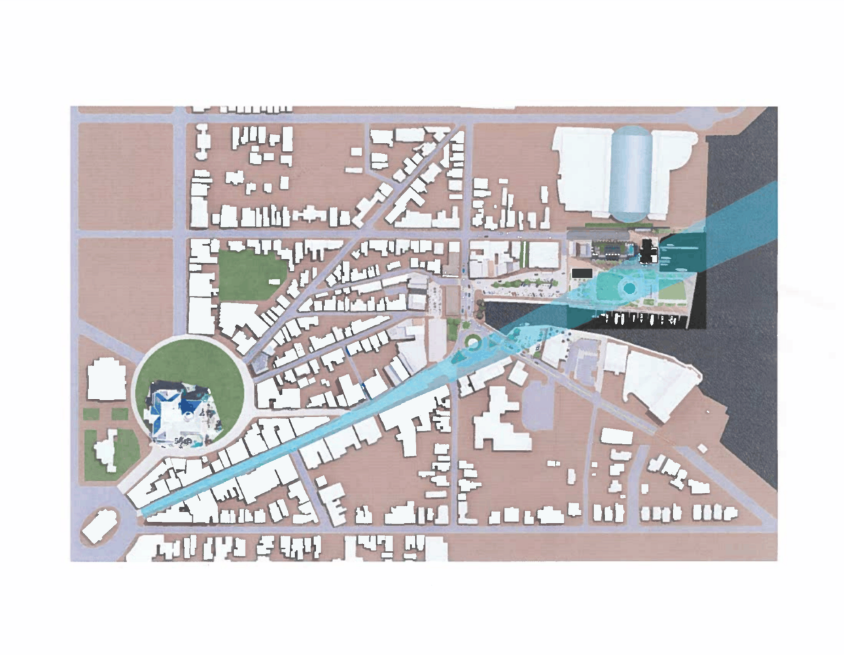
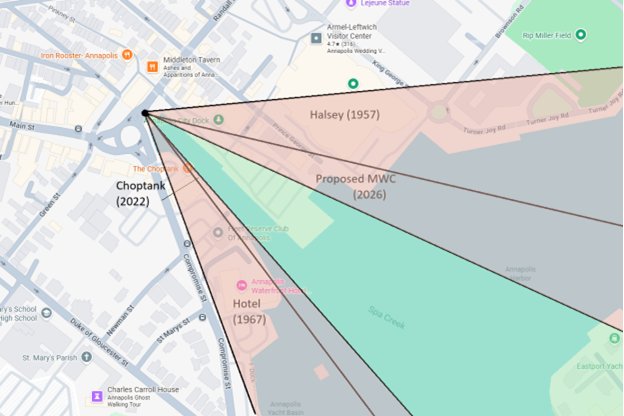
The view at Ego Alley’s edge has been steadily reduced since the mid-20th century. In the graphics below, red indicates the view that has been lost, and green is what will remain available if the MWC is constructed as currently planned.

What Preservation Means For Us
It is reasonable to ask why views matter, especially when you can just walk further down to see the bay. However, what we see now is a fraction of what was visible to Annapolitans in the early 20th century.
Much of the reduction of this sightline is the result of real estate development that occurred before height planning ordinances existed. Height and bulk ordinances exist to protect Annapolis’s cityscape, creating tangible regulations to safeguard a qualitative, often-subjective character.
In 1969, a coalition of citizens, including Historic Annapolis, fought to pass the first set of ordinances that regulated height in Annapolis; these ordinances are direct manifestations of their civic voices.
The MWC is one building, yet it is the successor to many previous attempts to construct oversized structures on the waterfront. To lose not just another swath of a beautiful view to the bay, but also to lose the integrity of Annapolis’s rigorous protection of its irreplaceable cultural resources, is to threaten a key component of Annapolitan identity.

This blog article represents the personal views of Ciel Smith.
If preservation of our city’s historic character and views are important to you, we want to hear from you and invite you to be a part of our community. You can sign up for our newsletter or become a Historic Annapolis member on our website, Annapolis.org, or email us at preserve@annapolis.org.