
Greetings! Welcome to the second part of our blog series featuring new displays at the William Paca House & Garden. Here, I will discuss an exciting new addition to HA’s collection that fills a gap in our interpretation of enslaved labor at the Paca family’s residence on Prince George Street.

HA is proud to display a reproduction three-piece custom livery suit on a dress form to represent Denby, the Paca family’s enslaved valet and “trusty Steward” (Fig. 1). Existing primary source documentation reveals that Denby originally belonged to Annapolis lawyer Daniel Dulany the Elder, who married Henrietta Maria Lloyd Chew Dulany, Mary Chew Paca’s mother (Fig. 2). Upon Madame Dulany’s death in 1766, Denby at 46 years old was willed to the Paca family and came to live and work in this house. As noted in his personal correspondence, William Paca considered Denby his most trustworthy and reliable servant.[1]

The team and I worked to recreate Denby in the round in order to give greater voice and recognition of his presence and enhance the visitor experience at the Paca House. Research by HA’s former senior historian Jean Russo shed some light on Denby’s position before and after working for the Paca family.[2] However, further study was needed to understand how Denby might have appeared and interacted with the Paca family and their guests. For instance, we know that on November 16, 1765, Annapolis tailor Robert Pinkney recorded making Denby a “coat & waist [waistcoat] & 2 paire [sic] of brees. [breeches]” when he served Madame Dulany.[3] Although we don’t know whether they were part of a livery suit, it shows that Denby was equipped with new and perhaps better-quality clothing by his previous enslaver—and, by extension, the Paca family.
Livery in 18th-century Europe and America evolved into the distinctive, often colorful uniforms worn by enslaved and paid household staff to show their allegiance and family’s wealth, status, and social standing. In the early American colonies, domestic enslaved laborers were outfitted in finer materials than field workers to serve as highly visible extensions of their enslavers’ prestige when welcoming guests or traveling. Livery designs were intentionally antiquated in their styling so that no one would mistake a liveried servant or enslaved worker for a free, upper-class citizen. Features of livery include two-colored coats with contrasting linings and facings, as well as gold or silver lace on the coat and waistcoat. Most livery was made of wool “broadcloth” with a frock coat with standing collars and cuffs, a waistcoat, and knee-length breeches with a fall front.

As we worked to recreate a typical livery suit, one roadblock we encountered was the fact that a Paca family coat of arms doesn’t exist. Livery suits were designed using the family’s heraldic colors or those derived from their family coat of arms, and these designs helped identify the servant’s household. Based on this information, and knowing that Denby was once enslaved by Daniel Dulany, I decided to draw inspiration from the Dulany family coat of arms, whose colors included dark blue, red, and silver.[4] These colors were also found in other examples of livery made for the enslaved attendants of historic figures like George Washington, Thomas Jefferson, and Robert Carter of Virginia. For instance, Thomas Jefferson’s livery order in 1802 and 1807 was for “blue coats trimmed with scarlet,” with waistcoats of scarlet and silver lace.[5] I also took inspiration from other visual period sources, particularly John Hesselius’ 1761 portrait, Charles Calvert and His Enslaved Attendant, at the Baltimore Museum of Art (Fig. 3).
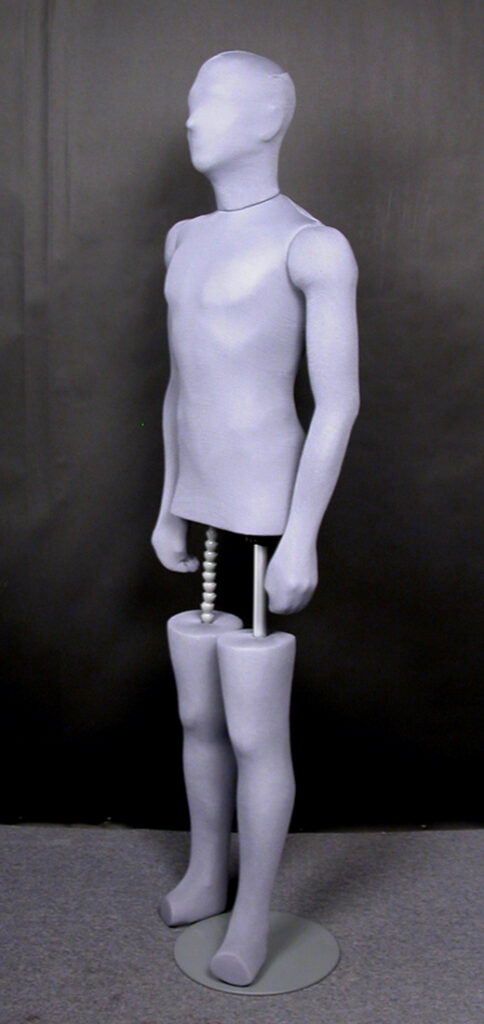
As part of my research methodology, I corresponded with various colleagues, including Amanda Isaac of Mount Vernon and Linda Baumgarten of Colonial Williamsburg. Both experts provided guidance on selecting period-appropriate livery styles and a mannequin that would better represent Denby. Richard Josey, Founder and Principal Consultant at Collective Journeys, also provided input and outlined ways for HA to interpret Denby in the house so that visitors can imagine his daily life as an enslaved domestic servant. With their help, I decided to select a gray museum-quality mannequin from Dorfman Museum Figures to ensure the outfit’s long-term preservation (Fig. 4). I sought to depict Denby with legs but no head and arms so that visitors can focus their attention on the articles of clothing. While selecting the mannequin, I connected with Keeley Sutphin, who operates her own reproduction clothing business, At The Sign of the Magpie, in Williamsburg. As an independent seamstress, Keeley has experience recreating 18th-century men’s garments for museums and historic interpreters. Most notably, she constructed a livery suit depicting Charles Carroll of Homewood’s enslaved valet, William Ross, at Homewood Museum in Baltimore (Fig. 5).
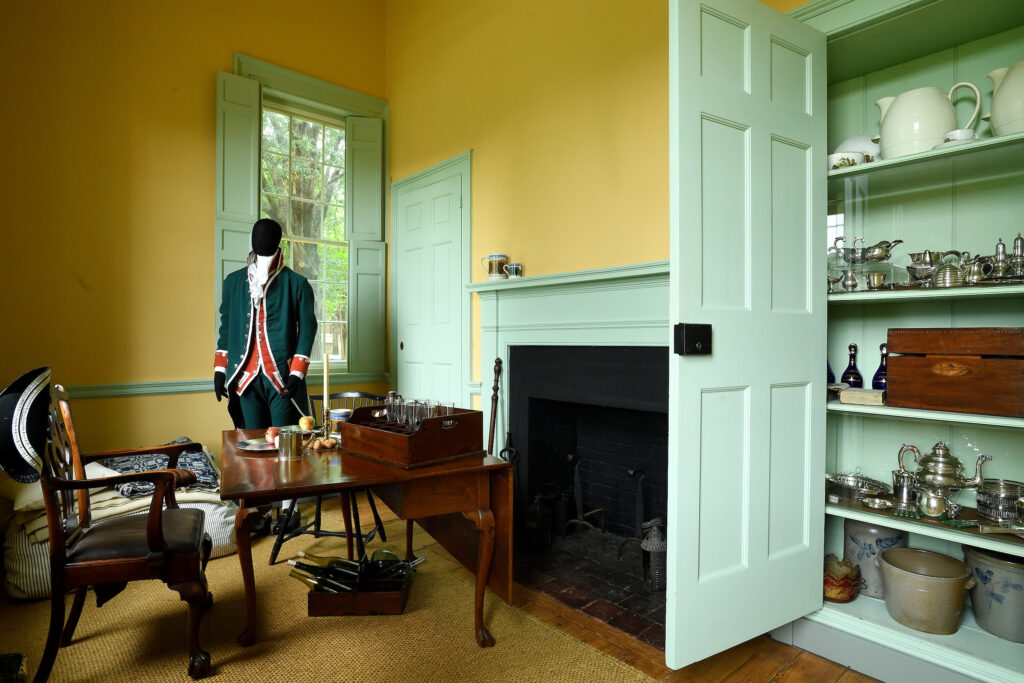
Together, we brainstormed and discussed the proper fabric, trim, and other accessories for our suit. Specific items that we purchased for this project include wool cloth from Brunley and Trowbridge, shoes and stockings from Samson Historical, and silver-plated (or “white metal”) buttons and metallic silver lace shipped over from Canada. Kim Walters of the Annapolis Living Historians also donated white metal shoe buckles from her Etsy shop, Sign of the Gray Horse. Once we acquired everything, Keeley was able to construct the entire outfit—from the linen shirt and cravat to the frock coat—in two months and deliver it with the mannequin on March 19, 2026, shortly after we reopened the Paca House to the public (Fig. 6).
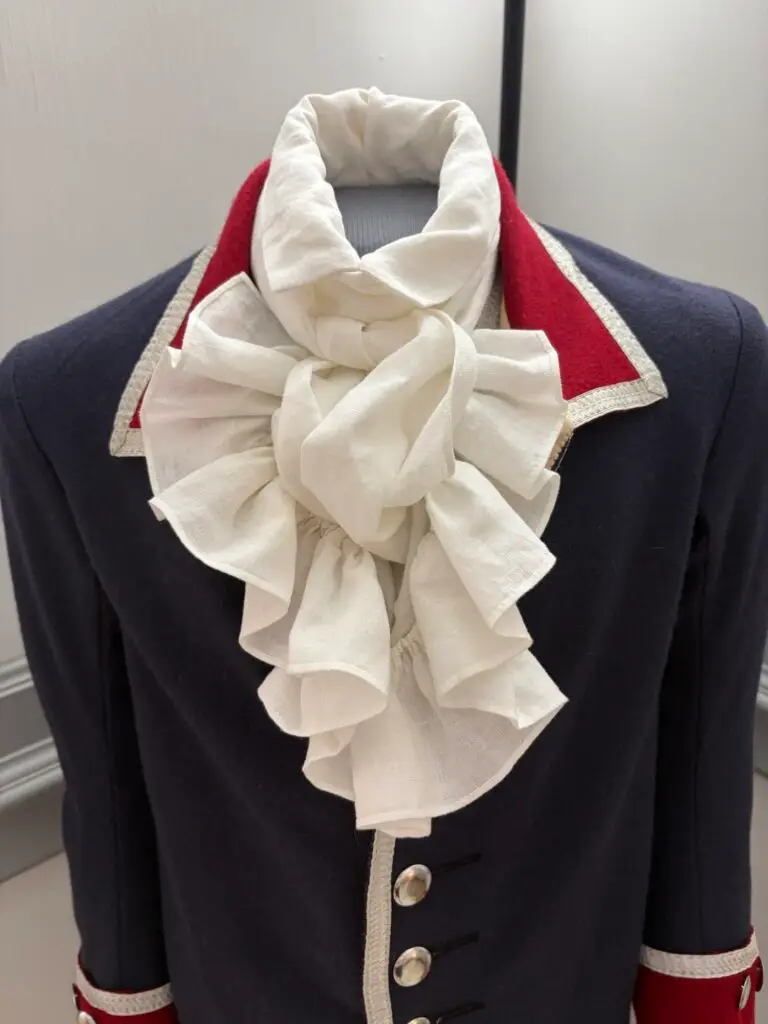

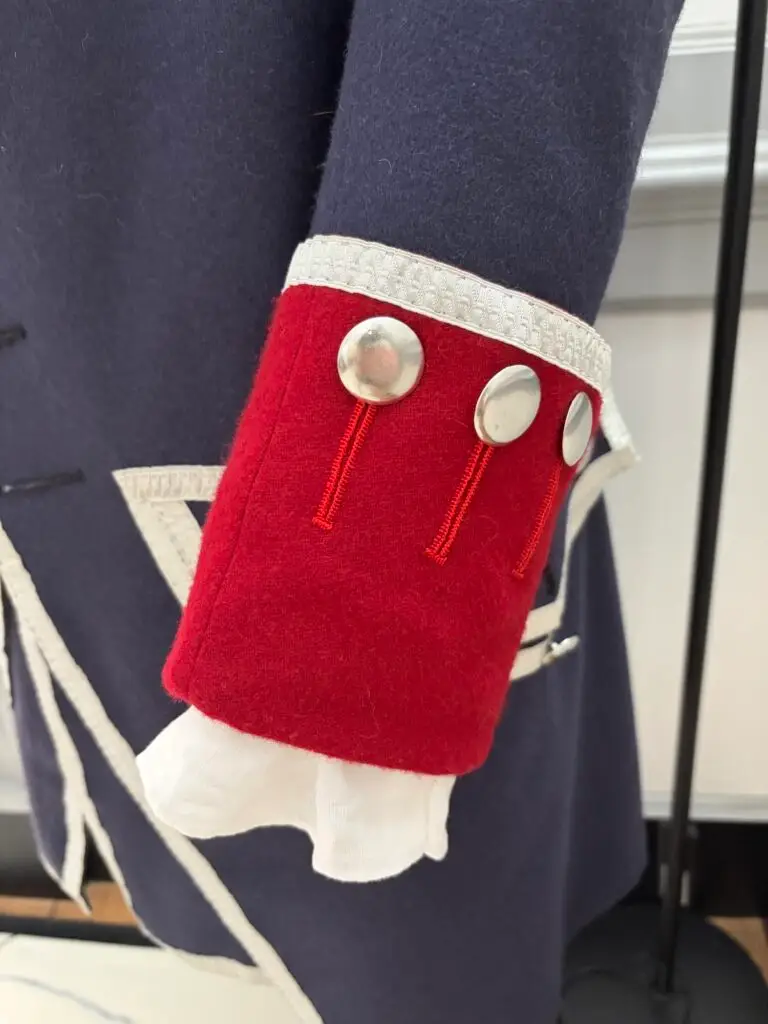
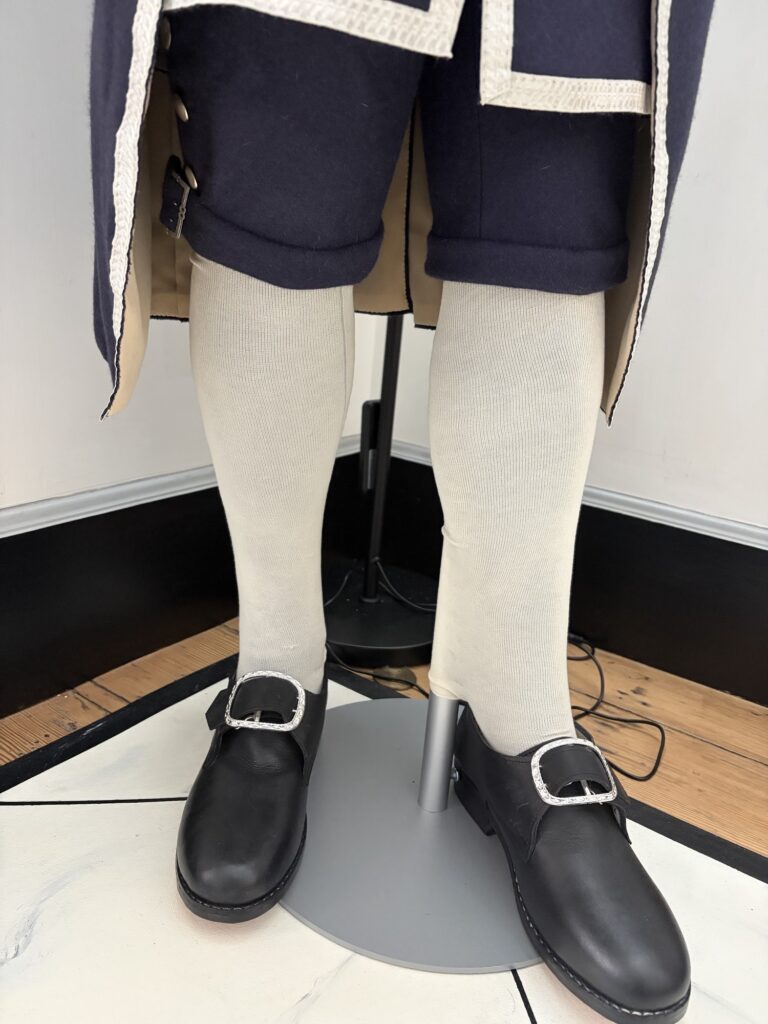
Figure 6. Detailed photos of the livery featuring cravat, metallic lace, buttons, and shoes with buckles.
In conclusion, this livery suit allows us to examine Paca’s role in the American Revolutionary movement while also considering enslavement’s centrality in the nation’s founding. Denby’s display embodies the struggles of enslaved people to retain their personal agency and recognizes the Paca family’s dependency on the unpaid labor of enslaved people to support their elegant lifestyle. By wearing traditional European livery composed of luxurious laces and designs inspired by the coat of arms of Anglo-American families, enslaved public-facing attendants were considered living status symbols whose fine clothing communicated the wealth of the elite family they served while constraining their humanity and individuality. As we celebrate America’s 250th anniversary, the presentation of Denby in the Paca House provides us the opportunity to reflect on the clothing choices that were offered to these highly visible servants, allowing us to tell a fuller and more balanced story detailing the lives and contributions of William Paca’s enslaved laborers.
Elizabeth Fox
Curator, Historic Annapolis
[1] In 1771, six years before signing the Declaration of Independence, William Paca was proposed for membership into Annapolis’s newly established social organization called the Homony Club. When the Club’s secretary failed to record this fact, William Paca wrote to the new secretary, William Eddis, humorously mocking him for “neglect of duty” and indicating he will receive a strong box “by my trusty Steward Denby Stable Esq.” (Letter from William Paca to the Homony Club, December 14, 1771. Historical Society of Pennsylvania, Dreer Collection, Vol. 2, p. 50.)
[2] Inventory of Daniel Dulany, Esqr. (1754) lists “1 Negro Man named Danby,” Maryland State Archives, Testamentary Papers, Box 55, Fol. 42, p. 12. Inventory of Henrietta Maria Lloyd Chew Dulany (1766) references “Denby about 46 years old,” Maryland State Archives, Prerogative Court Inventories, p. 12.
[3] Robert Pinkey Account Book (1764-1766), Maryland State Archives, M217.
[4] References to the colors and illustrations of the Dulany family coat of arms were found in Esmeralda Boyle’s Biographical Sketches of Marylanders (1870); Emily Emerson Lantz’s Maryland Heraldry (1905), p. 1; Charles Knowles Bolton’s American Armory (1927); and Francis Sims McGrath’s Pillars of Maryland (1950). See also https://www.americanheraldry.org/heraldry-in-the-united-states/roll-of-early-american-arms/?_search=Dulany
[5] Invoice from tailor Thomas Carpenter, October 14, 1802-April 26, 1803. Thomas Jefferson Papers, Huntington Library, San Marino, California.